SYNCRO
INSIGHTS
PHYSICAL AI

5 MINS
|
30 July 2026
Summary: Manufacturing leaders today are asking an important question: How can collaborative robots improve workplace safety without slowing down production?
Collaborative robots (cobots) help organizations create safer work environments with force sensing, intelligent safety controls, proximity monitoring, and emergency protection mechanisms. By taking over repetitive, physically demanding, and potentially hazardous tasks, cobots reduce worker exposure to risk while maintaining productivity.
As factories become more automated, safety is no longer simply about keeping people away from machines. It is about enabling humans and robots to work together efficiently and safely within the same workspace.
Why Workplace Safety Matters in Modern Manufacturing
Every manufacturing facility faces operational challenges that can directly impact employee health and safety. Tasks such as lifting heavy components, loading machines, repetitive assembly, palletizing, and material handling can increase fatigue and strain over time.
Many workplace injuries are not caused by a single incident. Instead, they develop gradually through repetitive motion, awkward postures, overexertion, and continuous manual handling activities.
Research from the International Federation of Robotics (IFR) found that increased robot adoption was associated with approximately 4.3% lower workplace fatality rates and 3.2% lower injury rates across European industries, highlighting the role of automation in improving safety.
Collaborative robots were introduced to tackle these dull, dirty, and dangerous tasks while allowing workers to focus on higher-value responsibilities.
What Makes Collaborative Robots Different from Traditional Industrial Robots?
Feature | Traditional Industrial Robots | Collaborative Robots |
Human Interaction | Limited | Designed for collaboration |
Safety Approach | External guarding required | Built-in safety features |
Workspace Sharing | Restricted | Shared workspace possible |
Deployment Flexibility | Lower | Higher |
Programming Complexity | Often specialized | Typically user-friendly |
Ergonomic Assistance | Limited | Common use case |
While many collaborative applications can operate without traditional safety fencing, every deployment should still undergo a proper risk assessment before implementation.
How Do Collaborative Robots Increase Workplace Safety?
Collaborative robots improve workplace safety through four primary mechanisms.
1. Force and Torque Limiting Prevent Injuries
Unlike conventional robots that continue operating until externally stopped, collaborative robots continuously monitor forces generated during operation.
If unexpected contact occurs, the robot can automatically reduce speed or stop movement before excessive force is applied.
2. Human Detection and Proximity Monitoring
Modern collaborative robots can integrate with advanced sensing technologies, including:
LiDAR scanners create a 360° map of the robot's surroundings to detect obstacles and enable safe navigation.
Vision systems Use cameras and AI to identify objects, guide robot movements, and inspect parts with precision.
Safety light curtains instantly stop robot motion when a person or object crosses a protected safety zone.
Area scanners continuously monitor predefined zones and slow down or stop the robot when someone enters the area.
Proximity sensors detect nearby objects without contact, helping the robot avoid collisions during operation.
When a person enters a designated operating zone, the cobot can automatically slow down, modify its motion, or stop completely until the workspace becomes safe again.
3. Hazardous Task Automation
Many manufacturing processes expose employees to conditions that can increase safety risks. Collaborative robots can automate tasks involving:
Heavy component handling
High-frequency assembly operations
Palletizing and depalletizing
Exposure to elevated temperatures
Handling of potentially hazardous materials

Repetitive strain injuries
Heavy lifting injuries
As a result, workers spend less time performing physically taxing tasks and more time focusing on decision-making, quality, and process improvement activities.
How Do Addverb's Syncro Collaborative Robots Improve Workplace Safety?
Syncro combines force monitoring, safety controls, and intelligent sensing technologies to support safe human-robot collaboration across manufacturing applications.
Types of Collaborative Robots by Addverb
Syncro 5: Up to 5 kg payload, 650 mm reach, top speed of 1.2 m/s
Syncro 10: Up to 10 kg payload, 1300 mm reach, top speed of 2.4 m/s
Safety Standards of Syncro
To support safe deployment across manufacturing environments, Syncro is designed in accordance with internationally recognized safety and compliance requirements, including:
EN ISO 10218-1 – Industrial robot safety requirements
EN ISO 13849-1 – Functional safety of machine control systems
CE Certification – Compliance with applicable European health, safety, and environmental requirements
These certifications and compliance standards help ensure that Syncro can be integrated into manufacturing operations while supporting safety, reliability, and regulatory requirements.
For manufacturers, workplace safety improvements go beyond injury prevention. Reduced incident rates can contribute to lower downtime, improved workforce availability, greater operational consistency, and reduced costs associated with workplace disruptions.
Different Safety Modes Available for Every Level of Operation
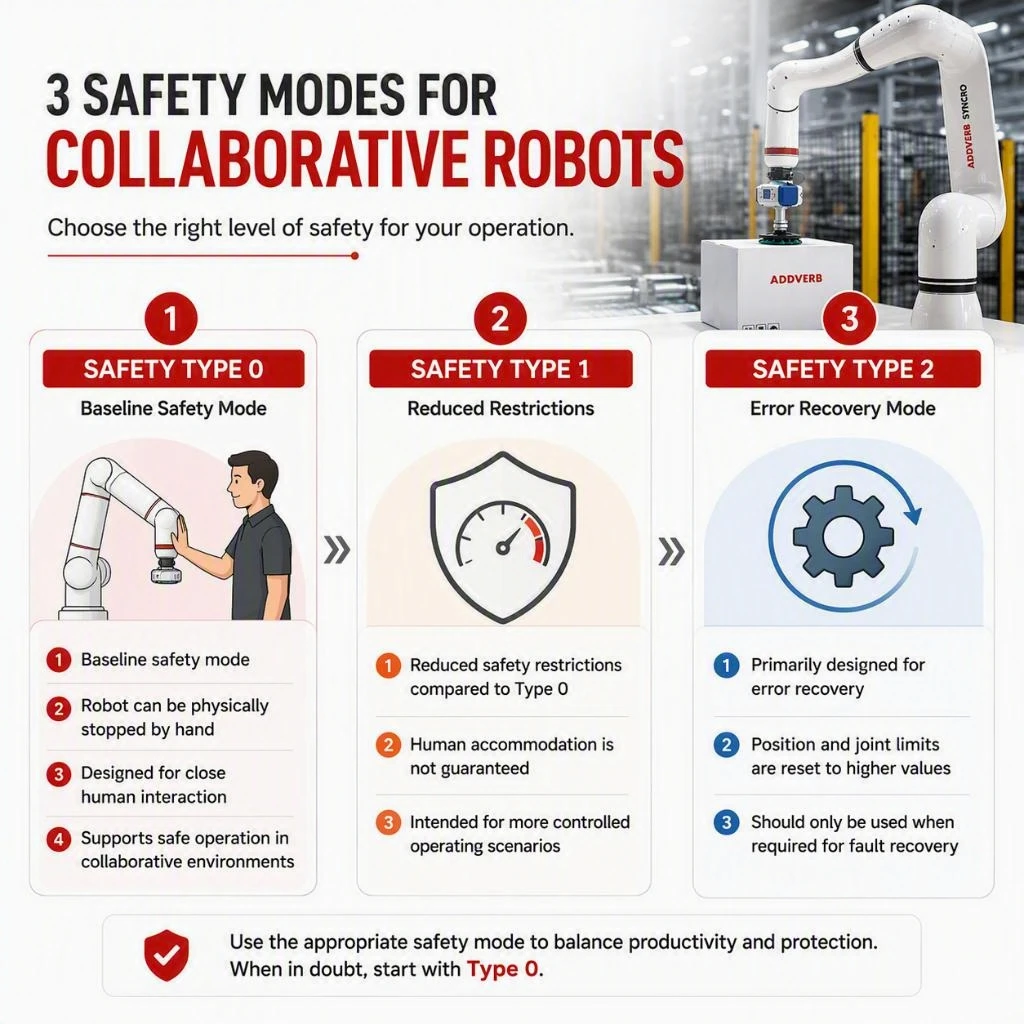
The cobot supports three safety levels that define how it responds to external forces and operational constraints.
Key Safety Capabilities Include
Joint torque limiting
Emergency Stop (E-Stop)
Payload awareness
Force estimation and collision response
LiDAR integration
Vision-system integration
Safety light curtain integration
End-effector force torque sensor support
These capabilities help manufacturers balance workplace safety requirements with operational efficiency.
Can Collaborative Robots Eliminate Workplace Risks Completely?
No. While collaborative robots can significantly reduce workplace risks, they do not eliminate safety responsibilities.
Successful deployments still require:
Workplace risk assessments
Employee training
Safety validation
Preventive maintenance
Compliance with applicable standards
Process-specific safety reviews
The safest manufacturing environments combine advanced automation with strong safety culture and employee operational awareness.
Why Human-Robot Collaboration Is Becoming the Future of Manufacturing
Beyond safety, collaborative robots are increasingly being deployed to support flexible manufacturing environments where production requirements change frequently. Their ability to be reprogrammed and redeployed quickly makes them valuable for high-mix, low-volume operations that require both automation and adaptability.
Organizations that successfully integrate human expertise with collaborative automation will be better positioned to improve safety, operational efficiency, and workforce productivity.
Conclusion
Collaborative robots are helping manufacturers address some of the most common workplace safety challenges, from repetitive strain and heavy lifting to hazardous material handling and machine tending.
With built-in safety features, cobots enable safer environment between workers and automation systems while maintaining operational efficiency. As adoption continues to grow, organizations that implement collaborative robotics will be better positioned to improve safety, productivity, and workforce well-being.
As manufacturers strive to improve workplace safety and operational efficiency, collaborative robots offer a practical way to automate repetitive and physically demanding tasks. When deployed with the appropriate safety measures and risk assessments, cobots can help create safer, more productive, and more flexible manufacturing environments.
Curious about how robots are learning to collaborate more naturally with humans? Explore our blog, Teaching Robots to Work in Sync, to discover how robotics research is advancing human-robot collaboration and the future of intelligent automation.
Frequently Asked
Do Collaborative Robots Always Require Safety Fencing?
How do collaborative robots detect human presence?
Which industries benefit most from collaborative robots?