ROBOTICS
EDUCATION
WHITEPAPER

13 MINS
|
3 SEPT 2026
01 · Executive Summary
India ranks among the world's top installers of industrial robots. Yet the engineers graduating from its colleges and universities have rarely wired a sensor, debugged a SLAM stack, or felt a cobot push back through a force-torque loop. The mismatch between what industry is deploying and what classrooms are teaching has become the single largest constraint on India's Industry 4.0 ambition.
This whitepaper documents how NAMTECH (New Age Makers' Institute of Technology, IIT Gandhinagar) designed a robotics curriculum that closes that gap by treating the curriculum itself as a product one co-built, stress-tested, and updated every semester with industry partners. We use the ten-day Autonomy in Robotics module, co-developed with Addverb's advanced robotics engineering team, as the running example throughout the document.
India installed 8,510 new industrial robots in 2023 a 59% jump over 2022, the highest growth rate of any major market that year.
Source: International Federation of Robotics, World Robotics 2024 Report.
Inside this whitepaper
How to read industry demand: a four-quadrant Job-Role Assessment that feeds the curriculum.
How to read learners: six entrant profiles, their secrets, and their trade-offs.
How to teach robotics: the four-thread, four-layer pedagogy that swaps lectures for manufacturing.
How to keep the curriculum alive: industry backward integration, demonstrated through the Addverb Autonomy module.
A robotics curriculum cannot be authored once and re-run. The only design that survives Industry 4.0 is one where industry rewrites a part of it every semester and where students graduate having manufactured a product, not just studied one.
02 · The Skills Imperative
India's Robotics Talent Crisis
Three forces collided over the last five years. Make in India and Atmanirbhar Bharat scaled domestic manufacturing. Global capacity diversified out of single-source geographies into India. And the National Education Policy (NEP) 2020 opened the door to multi-disciplinary, experiential degrees for the first time at a national scale. Demand for advanced-robotics engineers surged. Supply did not move.
The Indian robotics industry today is hiring for roles that did not formally exist in any university curriculum five years ago: AMR fleet managers, digital-twin architects, cobot integration specialists, human-robot collaboration designers. These are not future roles. Recruiters are filling them now, imperfectly, by retraining mechatronics or computer-science graduates on the job at a cost of 12 to 18 months per hire before real productivity is reached.
Metric | Value | Source |
Global rank, robot installation | #7 | IFR, 2024 |
Growth in India robot installs, 2023 vs. 2022 | 59% | IFR, 2024 |
MET roles NAMTECH targets by 2030 | 3M+ | NAMTECH internal projection |
The three structural breaks
Industry cannot find system-level engineers Companies deploying advanced robotics need engineers who can move between perception, control, and deployment not specialists trapped in any one of them. Indian curricula still split these into separate subjects, separate semesters, and often separate departments.
Education is rigid, siloed, and disconnected from Industry 4.0 The average Indian B.E./B.Tech graduate has spent more time on theoretical kinematics than on a single live robot. Lab time is rationed; industry exposure arrives in the final semester, after the curriculum is locked. The feedback loop from factory to syllabus is, in most institutes, measured in years, not weeks.
The gap widens, it doesn't close on its own Every Industry 4.0 capability that becomes mainstream humanoids, cobots in unstructured spaces, quadruped inspection, large-scale autonomy fleets adds a new role faster than the average institute can redesign a course. Without a continuous renewal mechanism, even a strong curriculum ages out within two cohorts.
03 · What Has Changed
Three Shifts the Curriculum Must Catch Up To
From silos to systems
The factory is no longer a collection of disconnected machines. AMRs, cobots, shuttles, vision systems and warehouse execution layers communicate continuously. An engineer who only knows the kinematics of a single arm but not how it negotiates with a fleet manager cannot deploy. The curriculum has to teach the system, not the part. NAMTECH's response is the four-thread architecture (Technology, Engineering, Design, Management) in which no thread runs without the others.
From software in a vacuum to Physical AI
AI in robotics increasingly described in the field as Physical AI is software that perceives, decides, and acts in the physical world. Unlike a model running in a clean data centre, it must obey gravity, friction, lighting, dust, and the unpredictable behaviour of human co-workers. When a cobot adjusts its grip strength on an SKU it has never seen before, or an AMR reroutes around a forklift that was not there a second ago, that is Physical AI in practice. Training engineers for it means putting them on hardware where the simulation breaks and teaching them to close the Sim-to-Real gap deliberately, not by chance.
From the perfect lab to the messy real world
A robotics course that only runs in a clean lab teaches students that the world cooperates. It does not. Lighting changes between morning and afternoon. SKUs arrive in non-standard packaging. A cobot's force-torque sensor responds differently on the third hour of a shift than the first. Industry-grade courses bake these constraints in from day one they are not the exception case, they are the curriculum.
Why experiential learning is non-negotiable in robotics
A lecture explains the factory. An experiential curriculum is the factory. In robotics the difference is decisive, because every concept in the discipline SLAM, sensor fusion, force-torque control, fleet coordination only becomes engineering knowledge once the student has watched it fail on real hardware and corrected it. Theory tells the student what should happen. Hardware tells the student what does.
This is why NAMTECH built its programmes around phygital labs, the Yo-Yo product-lifecycle programme, and six-to-twelve months of industry immersion with deployment partners. The model has already been validated at international level: a student from the inaugural NAMTECH cohort won India's first-ever podium finish at WorldSkills 2024 in the Industry 4.0 category, in Lyon an event that tests manufacturing execution, digital twin, AI and connectivity in a single benchmark. No lecture-led curriculum has reached that podium. Every one that has, was experiential.
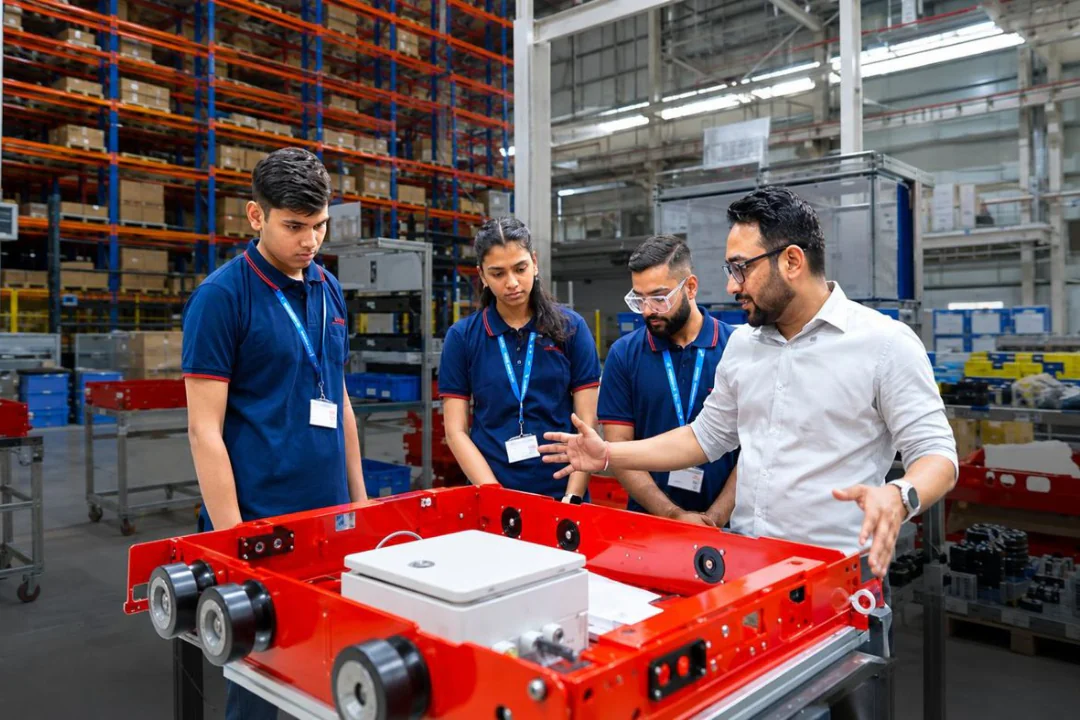
The shift is not from "less theory" to "more practicals." It is from a curriculum that describes the factory to a curriculum that is the factory sized down, instrumented, and lived in by students for the full programme.
04 · Learner Bifurcation
Six Profiles, Six Curricula
Robotics courses fail when they treat all entrants as the same student. The fresh B.Tech graduate, the ITI-trained shop-floor technician with five years of fault intuition, and the mid-career mechanical engineer pivoting into robotics each carry a different ceiling, a different risk, and a different blind spot. NAMTECH's curriculum was designed around six entrant profiles and the design starts by reading the learner before reading the syllabus.
Designing one course for all six profiles is the classical mistake. The architecture is six routes through a shared spine same labs, same projects, same backward-integration loop, sequenced and separated in different modules per profile.
 |  |
Academic Fresher Fresh B.E./B.Tech, zero industry experience, employment pressure. Enters Masters in Robotics (2-year) or iPMP. ——- Strategic secret Fastest learner no bad habits. The most challenging of all six profiles. The physical model was built for this profile. ——- Trade-off Fastest learner no bad habits. The most challenging of all six profiles. The physical model was built for this profile. ——- Medium (9–12 months) Very high ceiling | Medium risk | Industry Fresher ITI/Diploma, 0–2 years on the shop floor, role stagnation. Enters iPTP Industrial Robotics (1 year) or vocational stream. ——- Strategic secret Machine intuition can feel a fault before the sensor reports it. No classroom can manufacture this. ——- Trade-off Abstraction ceiling. Excels on the floor, struggles with system-level design. Plateaus without scaffolding. ——- Fast (6–9 months) Medium ceiling | Low-medium risk |
 |  |
|---|---|
Field Diverter ——- Strategic secret Cross-domain synthesis. A mechanical engineer who learns robotics knows why each interface meets a physical system. ——- Trade-off Identity lag. 12–18 months of cognitive split between old discipline and new one before peak performance returns. ——- Medium (9–12 months) Very high ceiling | Medium risk | Managerial Diverter Technical-to-management track, 8–15 years experience, organisational opportunity. Enters Executive iPMPX (6–9 months). ——- Strategic secret The translator class. Converts shop-floor reality into boardroom language. Increasingly rare and increasingly priced. ——- Trade-off Technical credibility erodes permanently. Cannot return to deep hands-on work. ——- Fast to management track Ceiling at COO | Low risk |
Two more profiles to design for
 |  |
|---|---|
Professional Learner | Self Learner MOOCs, GitHub, tinkering. Highest variance group. Strategic secret: the top 5% outperform every other profile; the rest stay invisible to formal hiring gates because they have no credential to clear the filter. |
05 · Curriculum Feed
Reading Industry Before Writing the Syllabus
Run the Job-Role Assessment before writing the syllabus. Without it, an institute risks teaching depth in roles industry can already source, and missing the roles industry cannot.
Before NAMTECH wrote a single module, the team ran a Job-Role Assessment across more than 20 industry partners Addverb, ABB Robotics, Schneider Electric, Festo, Micron, AM/NS India and others. The exercise is the upstream half of the curriculum: what industry already has covered, what it cannot find, what needs upskilling, and what is coming next. It is run every semester.
The four quadrants
Quadrant | Action | What it covers |
LACKING | Priority curriculum build | Roles industry needs and cannot fill. AI Robotics Engineer (computer vision, deep learning, ROS 2). Cobot Integration Specialist (force-torque, safety systems, APIs). These are the modules NAMTECH builds first and updates most aggressively. |
SUFFICIENT | Maintain baseline coverage | Roles industry can already source. Industrial Robot Operator. PLC/SCADA Engineer. The curriculum maintains coverage but does not over-invest. Resources released here are redirected to the Lacking quadrant. |
UPGRADATION | Reskill the existing workforce | Roles that exist but whose skill base is becoming obsolete. Smart Manufacturing Technicians needing IIoT and edge computing. Mechatronics engineers needing sensor fusion and embedded systems. NAMTECH addresses this through certificate and executive programmes. |
FUTURE FORECAST | Seeded 2–3 years ahead | Roles emerging now, mainstream by 2028–2030. AMR Fleet Manager. Digital Twin Architect. Human-Robot Collaboration Designer. NAMTECH seeds these into the curriculum two to three years before industry begins hiring at volume. |
Why the Lacking and Forecast quadrants matter most
A curriculum can be safe and irrelevant at the same time. If it concentrates on Sufficient roles, students graduate into a market that doesn't need them. The two quadrants that earn the curriculum its right to exist are Lacking (where industry hires immediately) and Future Forecast (where the next two cohorts will graduate into a wave of new demand). NAMTECH builds and updates these every semester.
06 · Pedagogy Architecture
Four Threads, Four Layers, One Spine
With the job-role intelligence and learner profiles in hand, NAMTECH built a pedagogy with two perpendicular axes. The four threads describe what is taught. The four layers describe how it is learned. At the heart of the stack is the Yo-Yo programme a full-product-lifecycle module built under an MoU with MIT's Mechanical Engineering department, adapted from MIT's 2.008N course, in which students take a product from concept through materials, machining, production, QC and final assembly. Every module including the Addverb Autonomy module we use as the running example sits in both grids.
The four-thread curriculum architecture
Thread | What it carries |
Technology | IIoT, digital twin, AI, AR/VR, cybersecurity. The information backbone of a Physical AI system. |
Engineering | Robotics, PLC, mechatronics, additive manufacturing, autonomy. The physical-system backbone. |
Design | Product design, prototyping, CAD/CAM, systems engineering. The creator layer students design EoAT (End-of-Arm Tooling) and control logic, not just operate it. |
Management | Leadership, techno-management, communication, supply chain. The thread that turns engineers into deployers and deployers into leaders. |
The four learning layers
Layer | What happens, in operational language |
Microlearning factories | Real-world problem sets delivered as short, contextual modules. The student's first contact with the system. |
The Yo-Yo programme | Students take a product from concept through materials selection, machining, production, quality control and final assembly the full lifecycle, lived, not lectured. Built under an MoU with MIT MechE; India's first formal embedding of MIT's 2.008N methodology in a curriculum. |
Phygital labs | AR/VR overlays on physical equipment. Daily hands-on time at scale, without the bottleneck of one-robot-one-student lab booking. |
Industry immersion (6–12 months) | Real-world deployment with an industry partner. Capstone and live industry projects assessed by the partner, not by faculty alone. |
The pedagogy architecture, in stack order
Theory → Microlearning factories: real-world problem sets, contextual foundation. Phygital → the Yo-Yo programme: full product lifecycle, MIT MechE 2.008N. Phygital labs: AR/VR overlays on real equipment, daily hands-on. Industry → industry immersion: 6–12 months live deployment with a partner. Running across all layers, the four threads: Technology (IIoT, digital twin, AI, AR/VR, cybersecurity), Engineering (robotics, PLC, mechatronics, additive manufacturing, automation), Design (product design, CAD/CAM, systems engineering) and Management (leadership, techno-management, communication, supply chain).
Proof of pedagogy WorldSkills 2024, Lyon
The model produced India's first-ever podium finish in WorldSkills Industry 4.0 a Bronze medal at Lyon, France, won by a student from NAMTECH's inaugural cohort. The competition tests manufacturing execution, digital twin, connectivity, AI and ML simultaneously every one of NAMTECH's pillars in a single benchmark.
Validating the model in a single cohort, against the international standard, is uncommon. It is also a signal that the four-layer stack works at international competition level. Threads describe content. Layers describe contact. A curriculum that gets the threads right but the layers wrong is a textbook. A curriculum that gets both right is a manufacturing line that produces engineers.
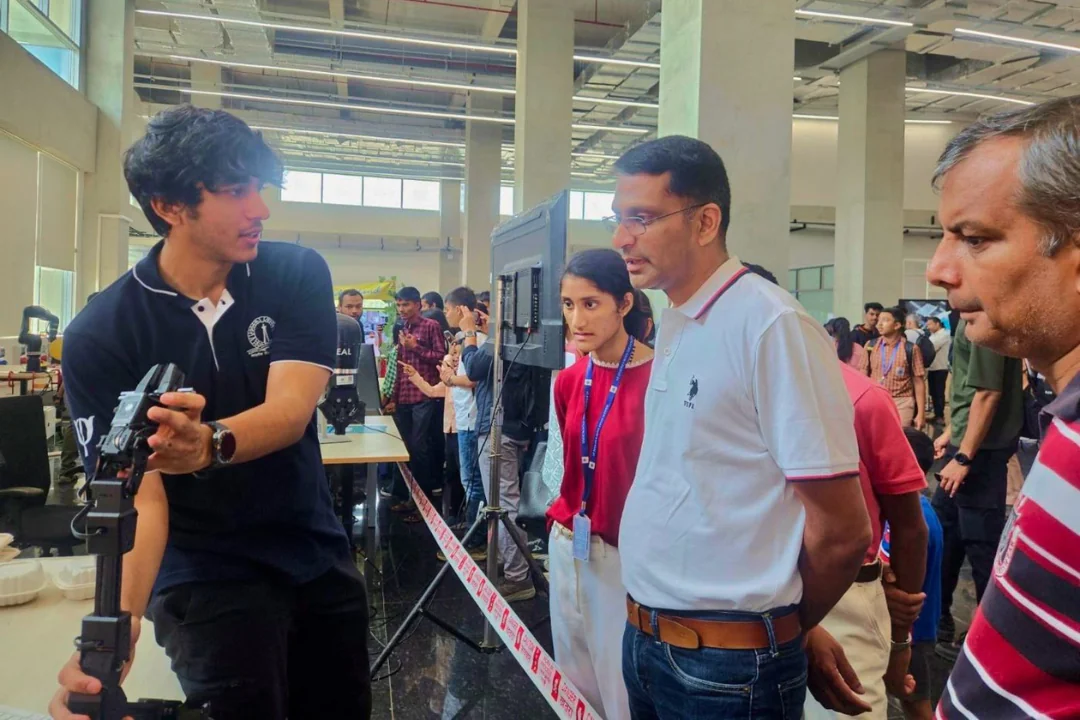
Key stat ₹16 lakh top package, ~50% of the inaugural class offered ≥ ₹10 lakh, class-average ~₹8 lakh AY 2024–25 placements.
Source: NAMTECH AY 2024–25 placement data.
07 · Backward Integration in Practice
How Industry Rewrites the Curriculum Each Semester
Backward integration is what keeps the curriculum from ageing. Every semester, the cycle runs: industry gap analysis → curriculum co-design → phygital lab delivery → capstone and live projects → industry immersion. Four data sources feed it: employer hiring data, technology evolution signals, immersion insights from currently deployed students, and project outcomes from the last cohort.
Nothing in the curriculum is more than a semester away from a re-write. To make this concrete, the rest of this section follows one module the ten-day Autonomy in Robotics module through the cycle. It was co-designed with Addverb's advanced-robotics engineering team and is now part of the NAMTECH Master's pathway.
Industry backward integration cycle
1. Industry gap analysis employer hiring data + tech evolution.
2. Curriculum co-design industry partners + NAMTECH faculty.
3. Phygital lab delivery AR/VR + physical equipment, daily use.
4. Capstone & live projects real industry briefs, partner-assessed.
5. Industry immersion 6–12 months on a live deployment.
Industry feedback loops from step 5 back into step 1.
The Module: 10 days, 60 contact hours, 9 instructors
The module sits in the Engineering thread and runs across phygital labs (Layer 3) into capstone (Layer 4). It covers the full stack of autonomy from architectural principles to a deployment-grade capstone.
Concept | Skill the student leaves with | Hardware / software stack |
Introduction to Autonomy | Reactive vs deliberative autonomy; levels of autonomy in robotic systems | MATLAB, ROS |
Autonomous Navigation Systems | SLAM and GPS-denied navigation in mobile robots | ROS (gmapping, hector_slam), MATLAB, OpenCV; LIDAR, GPS |
Path Planning Algorithms | A*, Dijkstra, RRT, PRM implementation & obstacle avoidance | MATLAB, Python (NumPy), ROS (MoveIt) |
Autonomous Control Systems | PID, LQR, Model Predictive Control for autonomous behaviour | MATLAB, Simulink, Python |
Perception for Autonomous Robots | Sensor fusion across LIDAR, cameras and IMU | MATLAB, ROS, OpenCV; LiDAR, IMU, RGB-D cameras |
Localization Techniques | Markov localization, particle filter, odometry, GPS | MATLAB, Python (SciPy), ROS (robot_localization) |
Motion Planning and Control | Kinematic and dynamic models, trajectory generation | ROS (MoveIt), MATLAB, Python; mobile robot with actuators |
Learning-Based Autonomy | Reinforcement learning, imitation learning, policy optimisation | PyTorch, TensorFlow, ROS, MATLAB |
Swarm Robotics | Decentralized control, communication, collective behaviour | Python (SwarmPy), ROS; swarm robot kits |
Human–Robot Interaction | HRI design, collaborative autonomy, user interfaces | ROS, Unity, Python; mobile robots and RGB-D cameras |
Field Robotics + Capstone | Terrain adaptation, energy management; deployment-grade capstone | MATLAB, ROS, Python, OpenCV; full mobile-robot stack |
How industry sharpened the curriculum
The first draft of the module was authored by NAMTECH. Addverb's engineering team reviewed it and fed back a series of revisions before the module went live. The pattern of those revisions is itself the proof that backward integration is a working mechanism, not a slogan.
Bring AI into Trimester 2, not Trimester 3 Introduction to AI in Robotics, Traditional AI, and a follow-on Advanced AI module were lifted earlier in the sequence. Robotics engineers are now expected to wire perception and learning into the same pipeline from the start separating them across trimesters delayed the moment of integration.
Replace dated material with what's now mainstream "Mobility on Air, Land and Sea" was replaced with a live Robot Development / Manufacturing project running through Trimester 1, so students graduate Trimester 3 with a robot they manufactured. "Security in Robotics" was replaced with Advanced Network Communication and Visual-Language-Action models closer to where the field is moving in 2026.
From Python-first to C++ / ROS first The draft taught Python, TensorFlow and PyTorch as the primary stack. Addverb engineers, deploying autonomy in production, asked for Modern C++ for Robotics and ROS to come first production code is C++, and Linux familiarity is a prerequisite, not an elective.
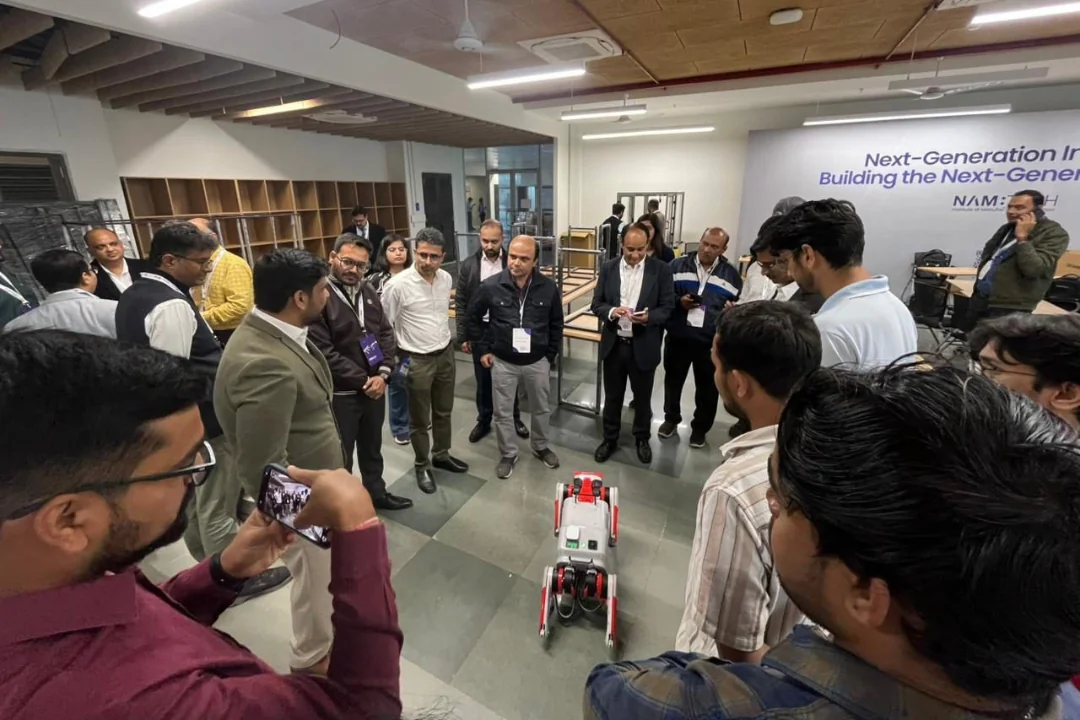
Backward integration is measurable. If the syllabus an institute taught last semester is identical to the one it teaches this semester, the loop is not closed. The Addverb revisions above moved three modules in a single cycle exactly what the mechanism is built to do.
08 · The Blueprint
A Reusable Six-Step Course-Making Process
Strip the NAMTECH model to its mechanics and what remains is a six-step process flow that any institute, any department, can adapt. The shape is independent of robotics it works equally for semiconductor manufacturing, smart manufacturing and any other applied engineering discipline where industry is moving faster than academia.
Market analysis Job-Role Assessment across 20+ industry partners.
Curriculum co-design academic + industry anchor per school.
Phygital delivery AR/VR labs, Yo-Yo, microlearning factories.
Programme development 6 routes for 6 learner profiles.
Industry immersion 6–12 months on a live deployment.
Outcomes & placement WorldSkills benchmark, placement tracking.
Course feedback runs from step 6 back into step 1.
Causal map six clusters that determine whether a robotics course works
Across NAMTECH's programme audit, six clusters consistently determine whether a course produces industry-grade engineers or shelf-grade graduates. Treat this as a checklist for course design.
Industry partners The list, the depth of engagement, and the cadence of contact. Names matter; semesters matter more.
Curriculum architecture The four threads, NEP 2020 alignment, the proportion of time in each layer of the learning stack.
Pedagogy model AR/VR integration, microlearning, phygital labs, the Yo-Yo programme the how, not the what.
Learner profiles Explicit segmentation of entrants and explicit scaffolding per profile.
Assessment and QA WorldSkills-grade benchmarks, industry reviews, backward integration cycle, placement tracking.
Academic partners International anchors who supply curricular methodology and global benchmarking.
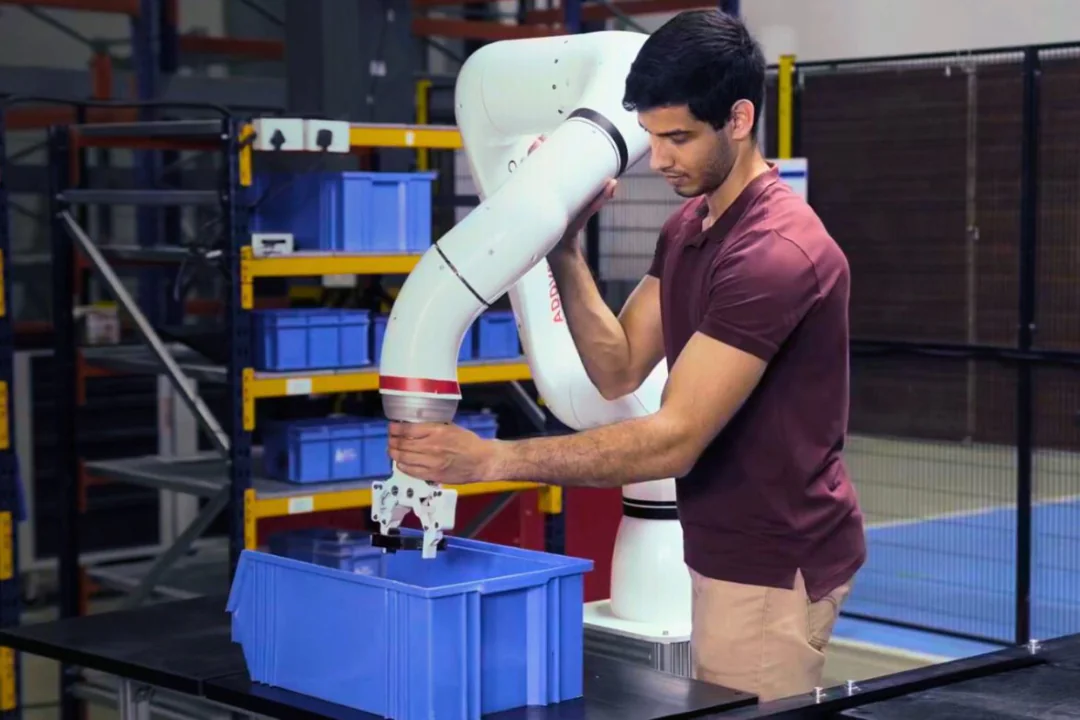
Most robotics courses get one or two clusters right. Industry-grade courses get all six right, every semester. The blueprint above is the minimum viable architecture it is also the maximum that any single institute can run without an industry-backward-integration loop.
09 · Outcomes
What This Architecture Produces
Selected recruiters
ArcelorMittal AMDEC. Micron. Addverb. GE Group. Hyundai. Lenskart. CG Semi. JBM Auto. Electrotherm. Recruiters are concentrated in advanced manufacturing, semiconductor, automotive, and advanced-robotics deployment the exact verticals the Job-Role Assessment flagged as Lacking and Forecast at the start of the design cycle. The placement list is a downstream measurement of an upstream design choice.
Result | Detail | Source |
Bronze | WorldSkills 2024, Industry 4.0 India's first podium | Lyon, France |
₹16L | Highest package AY 2024–25 | NAMTECH placement data |
~50% | Class offered ≥ ₹10L AY 2024–25 | NAMTECH placement data |
Three micro case studies profile to role
Academic Fresher → Advanced-Robotics Engineer A B.Tech graduate from the inaugural NAMTECH cohort entered the two-year Masters with no industry exposure. Eighteen months later, after immersion with an advanced-robotics partner, the same student was hired into a Robotics Engineering role moving from zero practical intuition to a deployment-grade engineer in less than two cohorts. The phygital model is built for this trajectory; the outcome is the proof.
Industry Fresher → Automation Engineer An ITI-trained shop-floor technician entered the one-year iPTP. The student brought machine intuition that no classroom can manufacture. The programme added the system-level scaffolding controls, perception, fleet coordination and the trajectory moved from Senior Technician to Automation Engineer in a single cycle. The trade-off (abstraction ceiling) was managed deliberately through targeted system-design coursework.
Field Diverter → Application Engineer A mechanical engineer with five years' experience entered the iPMP Bridge programme to pivot into robotics. The first three months were spent remapping the engineer's mental model from mechanical design to systems integration. By month nine, the student was placed as an Application Engineer at an industry partner the cross-domain synthesis that the profile predicted, realised inside one programme cycle.
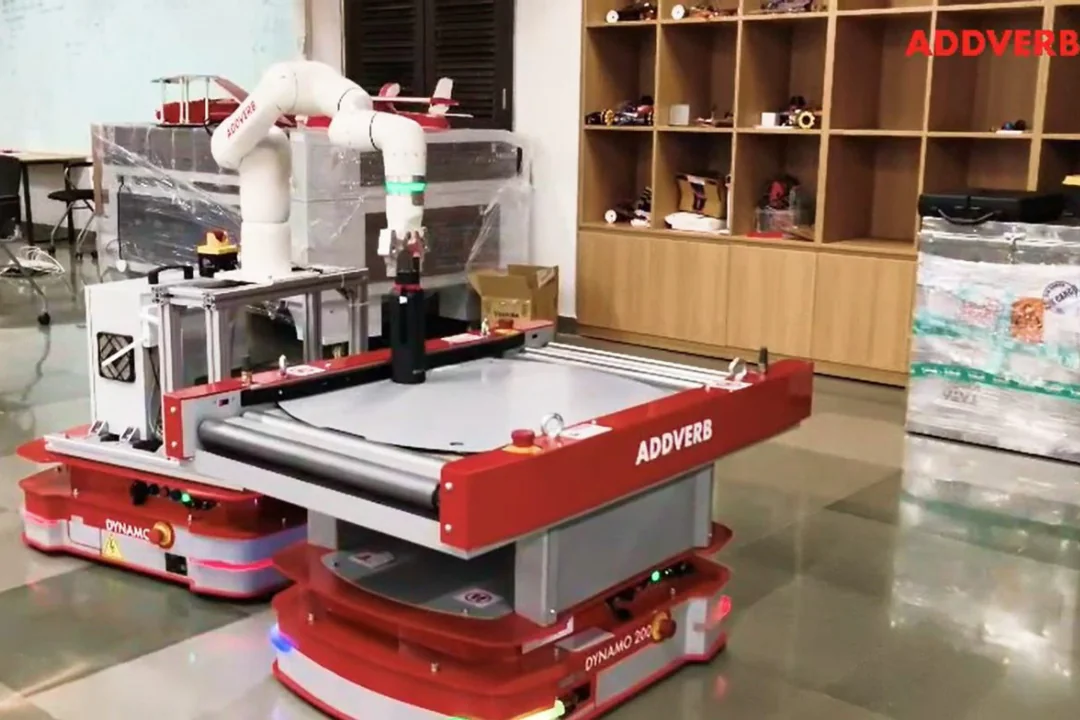
Outcomes are not the proof of a curriculum. They are the proof that the design decisions upstream Job-Role Assessment, learner bifurcation, four-thread architecture, backward integration were made deliberately. Replicate the decisions and the outcomes follow.
10 · The Future
Physical AI, Humanoids, and the Next Cohort
Three shifts are already visible in industry and will be in the curriculum within two cohorts. Institutes that seed these into the Future Forecast quadrant now will graduate engineers into them; institutes that wait will spend the late 2020s playing catch-up.
Physical AI as the default
AI in robotics is moving from a layer that runs alongside hardware to a layer that runs inside it. Visual-Language-Action models, on-device perception, and learned control policies will be standard in deployable cobots and humanoids before the decade closes. The curriculum response is to wire AI into the perception, control and decision layers from the first trimester not to teach AI as an elective.
Closing the Sim-to-Real gap deliberately
Simulation tools are getting cheaper and more accurate. Real-world deployment is getting more demanding. The gap between the two has become the single most valuable skill an advanced-robotics engineer can have. The curriculum response is to teach Sim-to-Real as a discipline students should fail in simulation, fail again on hardware, and learn the difference.
Humanoids, cobots, and quadrupeds as teaching instruments
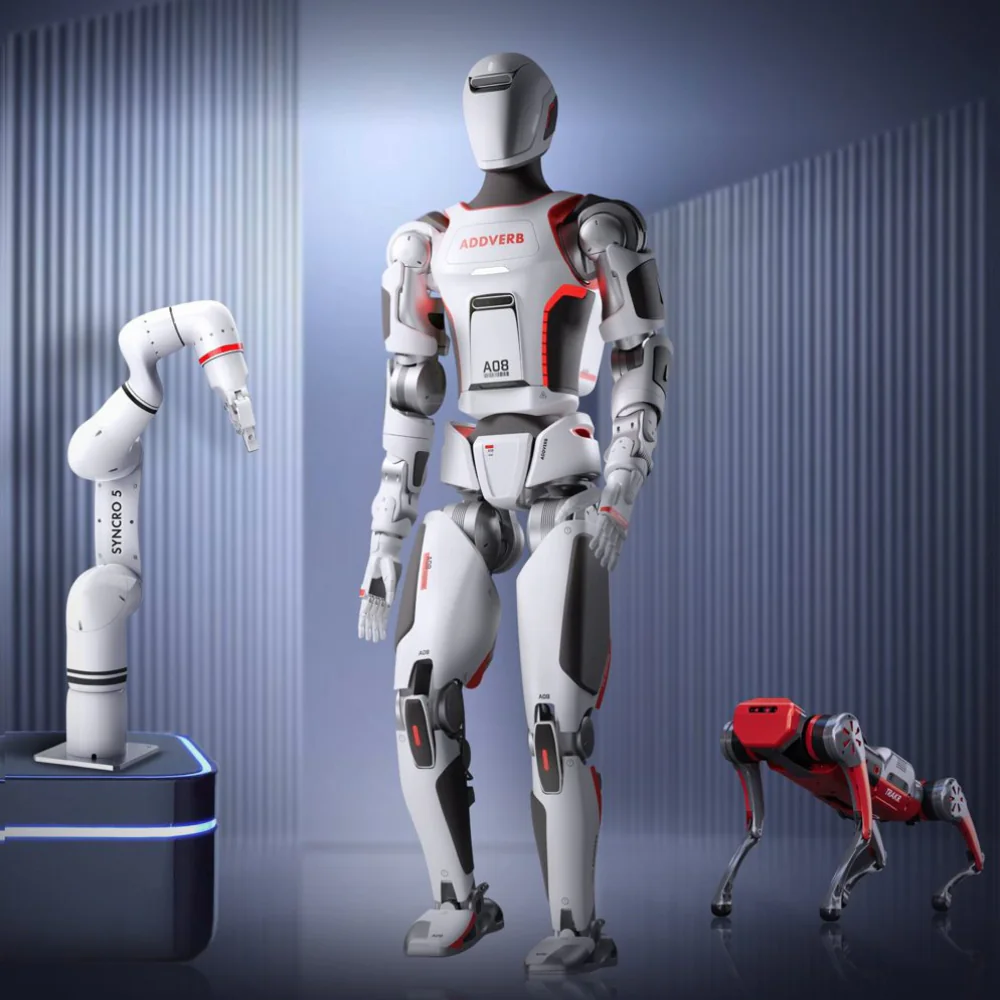
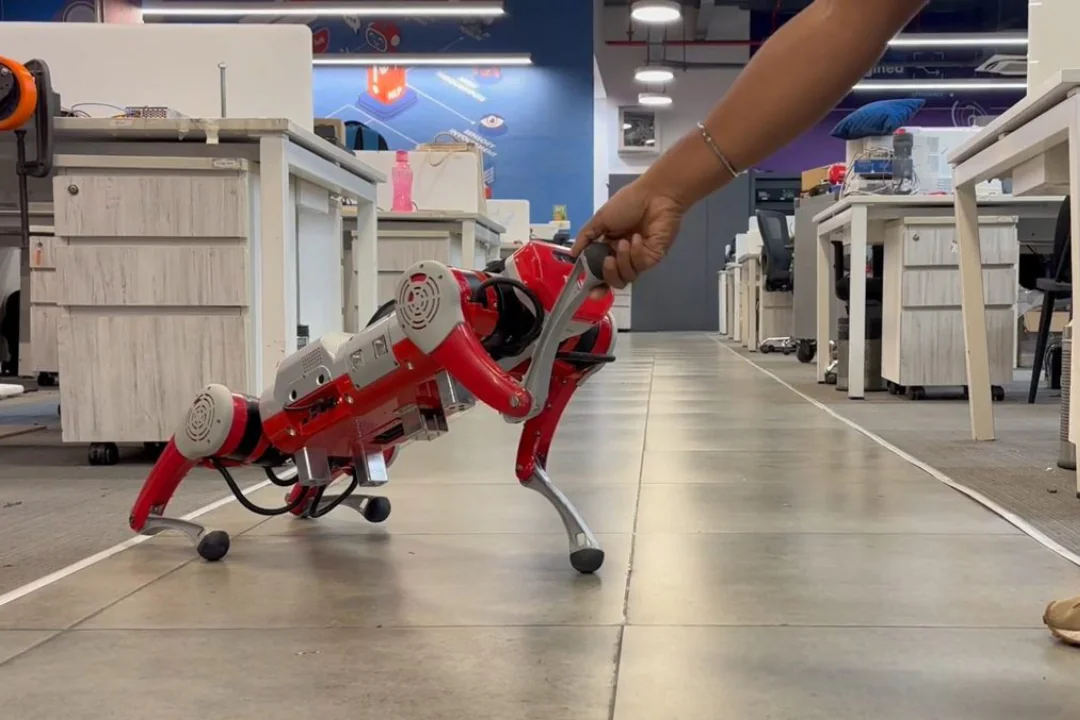
Advanced robotics platforms humanoids, cobots in unstructured spaces, quadruped inspection robots are no longer research curiosities. They are deployable today and will be widely deployed before 2030. Institutes that treat them as the teaching surface (rather than the textbook example) will produce the engineers who deploy them. NAMTECH's next-cohort design integrates Addverb's advanced-robotics platforms into the phygital lab stack for exactly this reason.
Global humanoid robot shipments are forecast to scale from ~12,000 units in 2024 to over 1 million by 2030 a 100× expansion in six years. India's share of that workforce will be decided by what its institutes teach in the next two cohorts.
Source: Goldman Sachs Research Humanoid Robots, 2024 update.
What the NAMTECH × Addverb model changes
Three things this architecture does that the traditional model cannot:
Curriculum updates in semesters, not years. Backward integration runs every cycle, with named industry partners and named module-level revisions.
The same architecture serves six entrant profiles. One spine, six routes the institute scales without diluting the model.
Students graduate having manufactured a product, not just studied one. The Yo-Yo programme and phygital labs make the factory the classroom.
11 · The Playbook
How to Build a Robotics Course
Eight steps. Plain language. For deans, registrars, department heads, policymakers anyone designing a course that has to keep up with industry.
Ask industry first. Write the syllabus second. Before you draft a single module, sit down with twenty companies who will hire your graduates. Ask: which roles can you not fill, which roles are you growing, which will you need in three years? The syllabus is downstream of those answers.
Not every student is the same. Build routes, not one course. Fresh graduates, working professionals and mid-career switchers all need different paths through the same content. Map your entrants before you start. Plan at least three distinct routes through one shared spine.
Bring industry to the curriculum table literally. Sign formal partnerships with the companies that will hire your graduates. Have them co-author modules. Have them review the syllabus every semester. The partnership is the curriculum, not an extra.
Build labs that look like factories, not classrooms. Layer digital tools onto real hardware. Give every student daily hands-on time. Make the lab the primary teaching space. Daily contact with the system matters more than weekly contact with the slide deck.
Make students build something they can hold. Send graduates out having manufactured a product end-to-end concept, materials, machinery, assembly, quality control. Theory tells the student what should happen; building a real product tells them what does.
Send students into real factories months, not weeks. Six to twelve months on a live deployment with an industry partner, assessed by the partner, not just by faculty. This is the curriculum, not an internship add-on. Real work means faster hiring and longer tenure.
Update the curriculum every semester. Build a formal feedback loop. Pull data from employers, technology shifts, immersion insights and project outcomes. Treat the curriculum as a product, not an institution. Anything older than two cohorts is at risk.
Measure outcomes, not exam scores. Track where your graduates land, what they earn, which roles they unlock. Benchmark against international competitions and global peers. Feed every signal back into the loop at Step 1. The loop only closes if the measurement is honest.
Build Your Robotics Course With Us
If you are designing a new robotics course or rebuilding one that is no longer matching industry we are open to collaboration.
Talk to ADDVERB For industry partners co-designing modules, hosting immersion cohorts, or building advanced-robotics deployment labs with us.
Published by Addverb Technologies, in collaboration with NAMTECH (New Age Makers' Institute of Technology). IIT Gandhinagar Campus in May 2026.
Frequently Asked
How do you design a robotics curriculum that keeps up with industry?
What should a robotics course actually teach?
Why do robotics graduates struggle to get hired in India?
Can one curriculum serve every kind of robotics learner?