COBOT
SYNCRO
PHYSICAL AI

5 Mins
|
19 OCT 2026
You have a 2.4 kg part, a 0.9 kg gripper and two spec sheets open side by side. The quick way to decide is to compare cobot payload and reach, see that the bigger arm covers everything with room to spare, and order it. That shortcut can cost precision and floor space for no gain. The better test for any cobot is where the tool has to arrive, and at what angle. If every target sits well inside 650 mm and the load is light, Addverb's Syncro 5 cobot is usually the better fit.
Key takeaways
Syncro 5 carries 5 kg at up to 650 mm; Syncro 10 carries 10 kg at up to 1,300 mm. Both are six-axis cobots.
Doubling payload and reach together quadruples the static moment the payload puts on the base joints, and multiplies its inertia about the base by eight.
Pick the arm whose comfortable working zone, not its maximum reach, covers every pose the task needs.
What is the difference between the Syncro 5 and Syncro 10 cobots?
On paper, the difference is two numbers, payload and reach, as listed in the Syncro technical specifications. Both arms have six degrees of freedom: six joints in series, which together set both where the tool is and which way it points.
For Syncro 10, the spec page also lists a 40 kg arm weight, ±0.1 mm position repeatability and 2.4 m/s maximum tool speed. It supports mounting in any orientation.
Syncro 5 | Syncro 10 | |
|---|---|---|
Rated payload | 5 kg | 10 kg |
Maximum reach | 650 mm | 1,300 mm |
Moment from rated payload at full horizontal reach (m x g x r) | 31.9 N·m | 127.5 N·m |
Payload inertia about the base axis (m x r²) | 2.1 kg·m² | 16.9 kg·m² |
Floor area inside the reach circle (πr²) | 1.33 m² | 5.31 m² |
Natural fit | Bench-top precision work, compact cells, research rigs | Tasks spanning stations, heavier tools, long paths |
The last three numeric rows are our own calculations from the rated figures. They cover the payload only and leave out the arm's own weight.
Why a longer-reach cobot carries four times the load?
A payload held at arm's length acts like a weight on the end of a lever. The shoulder and base joints have to hold a moment equal to mass x gravity x distance. Double both the mass and the distance, and that moment goes up four times, from 31.9 N·m to 127.5 N·m.
Acceleration is harsher still. Inertia scales with the square of distance, so the same payload change multiplies the resistance to fast rotation about the base by eight.
So Syncro 10 is a different design, not a stretched Syncro 5: its link stiffness, actuator sizing and joint limits must all accommodate those loads. Because the arm's own links add to every figure, the real gap at full stretch is wider still.
Why does a longer arm change how precisely the tool moves?
A longer arm turns the same small joint error into a larger error at the tool. Take a joint that is off by 0.01 degrees. At 650 mm, that is about 0.11 mm at the tool tip. At 1,300 mm, it is about 0.23 mm.
To hold the same precision, a longer arm needs tighter joint control and stiffer links. Neither comes without cost.
Orientation is the second issue. As an arm approaches full stretch, it nears a singularity: a configuration where some joints line up and the tool loses the ability to tilt in certain directions. Manipulability, the measure of how freely the tool can move in every direction, falls toward zero there. A 1,300 mm reach is the farthest point the tool can touch, not a promise that it can arrive there at any angle.
Also Read: Two arms, one handover: teaching robots to work in sync
Map the task before comparing cobot payload and reach
Four checks settle most decisions:
1.The farthest point and the tool angle there: Measure the distance from the planned base position to the hardest target. Note whether the tool must arrive vertical, angled or horizontal.
2.The real payload: Payload ratings cover everything on the tool flange, so add the gripper and cabling to the part weight, allow for any centre-of-gravity offset, then keep a margin.
3. Precision at that point: Write down the tolerance the task needs at its farthest target, not at the centre of the cell.
4. The space the cell can give up: A longer arm sweeps more floor, and the risk assessment must cover every square metre of shared space.
If every target sits comfortably inside 650 mm, and the tool-loaded payload is well under 5 kg, start with Syncro 5. If the task spans two stations or needs a tool of up to 10 kg, start with Syncro 10. If you are borderline on reach, move the base before you upsize the arm.
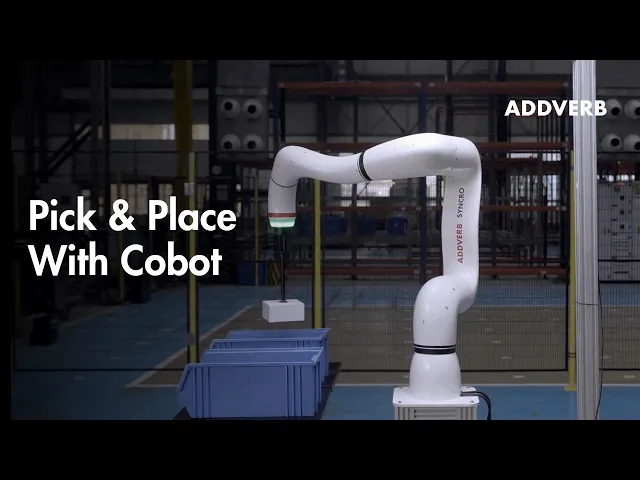
Where is Syncro 10 the wrong choice, and where is Syncro 5?
Syncro 10 is the wrong choice when the work is compact. You pay for a 40 kg arm and its mounting. On a shared bench, more of the space people work in also falls inside its reach circle.
Safety follows the application, not the robot alone. The 2025 revision of ISO 10218, and its Part 2 covers how robot cells are integrated. A collaborative-rated arm still needs a cell-level risk assessment.
Syncro 5 is the wrong choice when work sits at the edge of its 650 mm envelope, where it has the least freedom to orient the tool. It is also the wrong choice when the gripper alone consumes most of the 5 kg rating.
Also Read: Real research on a real robot: Addverb x IISc, Bangalore
Two short cobot arms can beat one long one
When a task looks too wide for Syncro 5, price a pair of short arms before committing to one long one. In work with IIT Gandhinagar, two Syncro 5 arms handed objects from one to the other using a shared progress signal to synchronise their timing. With the coupling active, every handover succeeded, five out of five for both a box and a bottle. Without it, every box handover failed, and the bottle succeeded once in five.
That is a lab result over five trials per object, not a production benchmark. It does show that two compact arms can cover a span neither reaches alone, with each arm working well inside its envelope.
Syncro also ships with an open Python and C++ software development kit (SDK) and ROS2 support. Teams writing their own coordination logic can start from the Addverb developer portal
Which Syncro should you shortlist first?
The one whose comfortable working zone covers every pose your task needs. In practice, that is the smaller cobot more often than a spec-sheet comparison suggests.
Run the four checks above before any vendor discussion. They tell you more than the headline payload and reach.
Frequently Asked
Is Syncro 10 just a bigger Syncro 5?
Can Syncro 5 lift a 5 kg part?
Which safety standards does Syncro list?
Can Syncro be taught without writing code?
Which tasks suit each arm?
How do I calculate the payload I need for a cobot?