HUMANOID
QUADRUPED
PHYSICAL AI

8 Mins
|
24 July 2026
Summary: Traditional AI lives in the digital world. It reads text, processes images, or writes code. Physical AI lives in your world - the one with gravity, slippery floors, heavy boxes, and people moving around unpredictably. A robot operating here needs far more than a clever algorithm. It needs sensors to feel, cameras to see, motors to move, and intelligence to tie it all together.
What is Physical AI?
Physical AI is what happens when artificial intelligence moves out of computers and into the real world through a robot’s eyes, hands, and legs. A robot powered by Physical AI can do four things: perceive, reason, adapt, and act. It can see what’s around it, understand what needs to be done, handle unexpected situations, and carry out physical tasks all in real time.
Physical AI represents the next major transition in robotics. Earlier generations of robots were largely designed as machines for repetition, automation, and task-specific autonomy. They followed programmed trajectories, executed defined workflows, and operated best in structured environments where uncertainty was minimised.
A useful academic definition is this: Physical AI is the field of embodied intelligence where robots use multimodal perception, learning-based cognition, predictive models, and real-time control to perform useful actions in the real world.
It combines robotics hardware, sensors, AI models, simulation, and real-time control systems.
The importance of Physical AI comes from the fact that the next generation of robots will not be limited to isolated repetitive tasks. They will be expected to work in warehouses, homes, factories, hospitals, public spaces, and unstructured environments. This requires robots that can safely adapt to dynamic environments and collaborate with humans.
In this sense, Physical AI is not just a new name for robotics. It is a new paradigm for robots as AI agents in the physical world.
From Repetitive Machines to Thinking Robots: A Quick History
Robots are not new. But the kind of robots we are building today is fundamentally different. This shift happened in three distinct stages.
Stage 1: Automation (1980s–2000s): Robots were primarily used for repetitive industrial tasks. Their main value was repeatability, speed, precision, and endurance. They performed welding, assembly, sorting, picking, storage, and transfer operations in controlled environments. These robots did not need broad cognition because the environment was engineered around them.
Stage 2: Autonomous Robotics (2000s–early 2020s): Robots gained mobility, perception, localisation, mapping, and task autonomy. Automated storage and retrieval systems, AMRs, AGVs, Addverb's Syncro and Trakr are examples of this stage, machines that could navigate or manipulate reliably, but within a fairly narrow, pre-trained scope. These systems could move through semi-structured environments, detect obstacles, localize themselves, and complete predefined tasks. However, their intelligence was still narrow. A warehouse robot could navigate a warehouse, but it could not generally understand the world like a human assistant. A cobot could perform a trained motion, but it could not easily generalise to a new manipulation task without reprogramming or retraining.
Stage 3: Physical AI (Today): In this stage, robots are increasingly expected to combine physical capability with human-like cognition. This does not mean complete human-level intelligence. It means that robots must connect perception, language, reasoning, action, and feedback in a unified loop. They must answer questions such as: What is the task? What object should be picked? Where should the robot move? How should the robot move? What is the safest trajectory? What force should be applied? Did the task succeed? What should be corrected if it failed? Addverb's move into humanoid robotics with Elixis-W reflects this shift, combining mobility, perception, and manipulation in one platform rather than treating them as separate problems.
This transition also changes the meaning of a robot. A robot was once considered a physical machine with software. In the Physical AI paradigm, the robot becomes a body for intelligence. It has sensors to observe, actuators to act, controllers to stabilize, and AI models to reason. This is especially important for humanoids, quadrupeds, mobile manipulators, and dexterous robots, where the boundary between mechanical design, perception, control, and intelligence becomes inseparable.
Why is Physical AI Harder Than Regular AI?
This is one of the most important things to understand: Physical AI is significantly more difficult than digital AI. A digital AI like a chatbot can make a mistake and output a wrong sentence. You simply ask again. A robot can make a mistake and fall, unable to perform a task or damage an object. This means Physical AI systems must be not only intelligent but also safe, reliable, and consistent under real-world conditions.
Physical AI is not just AI added to a robot. It is the deep integration of intelligence with a physical body. The robot must deal with gravity, friction, the weight and fragility of objects, noisy sensors, motor limits, and the unpredictability of human behaviour all at once, in real time.
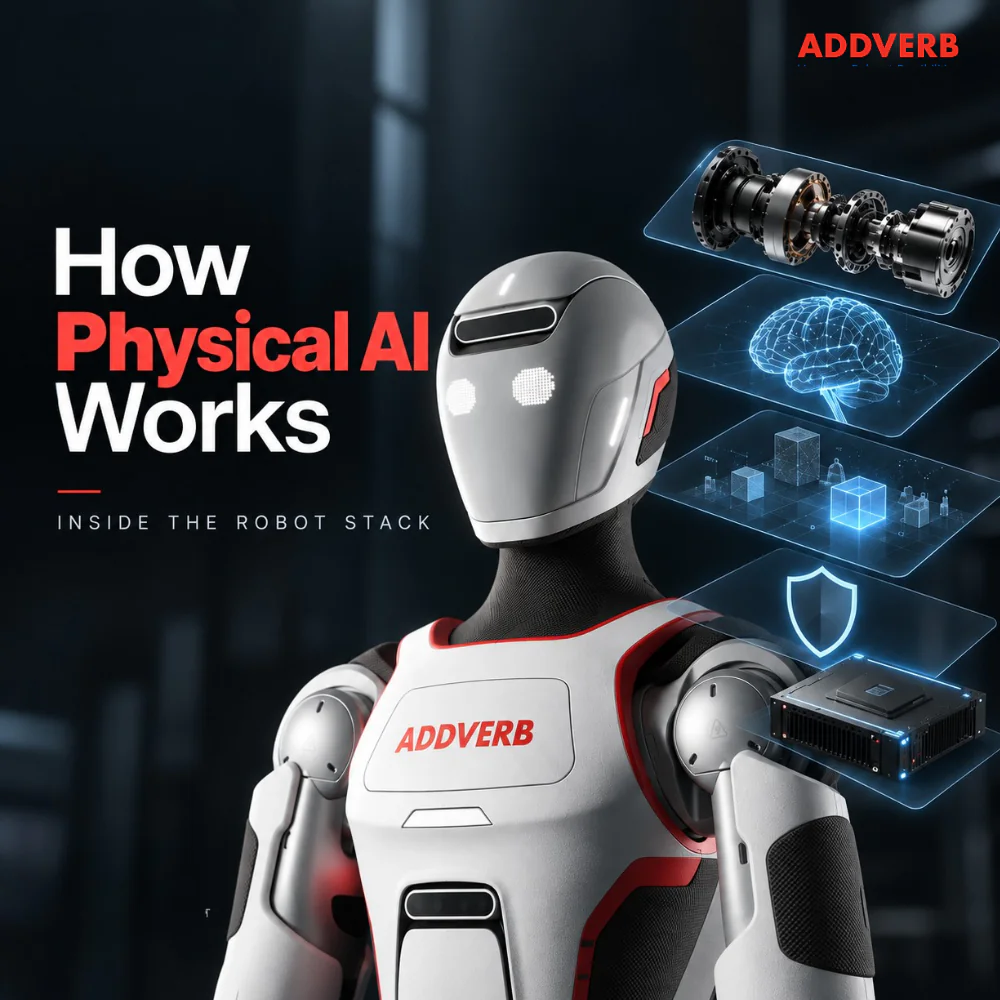
Physical AI must be understood as a full-stack system. At the bottom is robot hardware: the mechanical structure, joints, transmissions, actuators, batteries, connectors, wiring, and embedded compute. Above that is platform software: communication, drivers, operating systems, middleware, state estimation, safety, and real-time control.
Above this layer are perception and classical robotics tools such as object detection, SLAM, localisation, pose estimation, free-space detection, depth estimation, and motion planning. Above these are learning-based systems such as reinforcement learning, imitation learning, visual-language-action models, and world models. Finally, networking, cloud infrastructure, simulation, data pipelines, and deployment tools support training and scaling.
The key point is that Physical AI cannot be reduced to one model or one algorithm. A VLA policy may understand the task, but it cannot compensate for poor actuator response. A powerful world model may predict future states, but it still depends on calibrated sensors and reliable robot state estimation. A reinforcement learning policy may walk well in simulation, but if the actuator model is inaccurate or the real terrain distribution is different, the robot may fail. Therefore, the intelligence of a Physical AI system is distributed across the body, sensors, controller, model, data, and runtime.
This is not just a theoretical concern. When Addverb's own robotics lab at NAMTECH set out to combine the Dynamo 200 AMR with the Syncro 5 cobot into a single mobile manipulator, the hardest problems were never in one algorithm. They were in the mechanical design that kept the arm stable while the base moved, the electrical isolation that stopped the AMR's drive motors from interfering with the cobot controller, and the networking that let two completely different control stacks, Fleet Management and ROS 2, talk to each other without stepping on one another. Read the full project here: Mobility Meets Manipulation: A Mobile Manipulator from NAMTECH's New Addverb Robotics Lab.
This is why Physical AI is more difficult than digital AI.
Physical AI at a Glance
Feature | Traditional AI | Physical AI |
Works in | Digital environments | Physical environments |
Inputs | Text, images, data | Cameras, sensors, LiDAR, force feedback |
Outputs | Predictions and responses | Physical movement and actions |
Challenges | Accuracy and reasoning | Safety, motion, perception, manipulation |
Common Applications | Chatbots, search engines | Warehouse robots, manufacturing robots, healthcare robots |
The Two Core Capabilities of Every Physical AI Robot
At the heart of every Physical AI system are two fundamental capabilities.
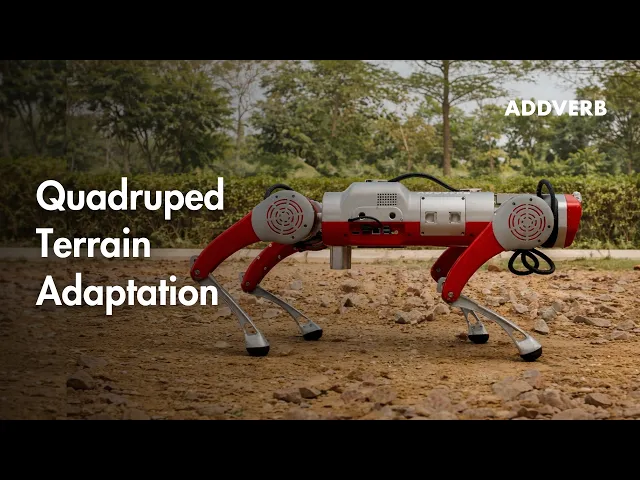
Locomotion Intelligence is the ability to move: Trakr, Addverb's quadruped, demonstrates this by balancing and navigating rough industrial terrain.
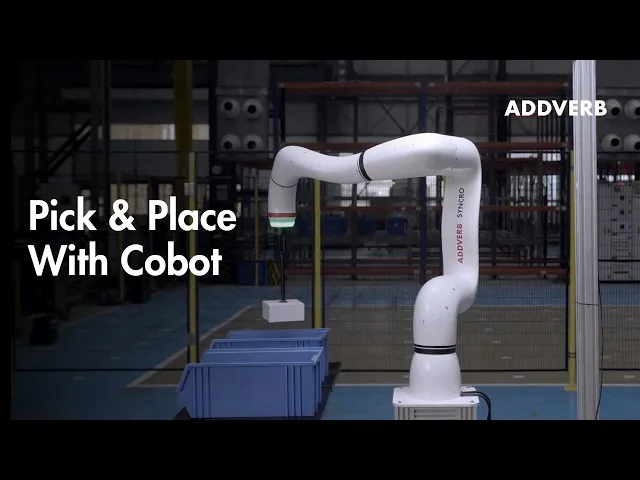
Manipulation Intelligence is the ability to interact with objects - The Syncro 5 cobot demonstrates this, using force and grip feedback to handle objects of varying weight and fragility.
Together, these two capabilities are what separate a Physical AI system from a simple automated machine.
The Future is Physical
We are at the beginning of a major shift. The next generation of robots will not be limited to isolated, repetitive tasks. They will work alongside humans in warehouses, hospitals, homes, and public spaces. Physical AI is the technology that makes this possible. It represents a fundamental change: from robots as machines that repeat programmed movements to intelligent agents that understand their environment and act purposefully within it. Ultimately, Physical AI is the science and engineering of making intelligence physically useful and we are only just scratching the surface.
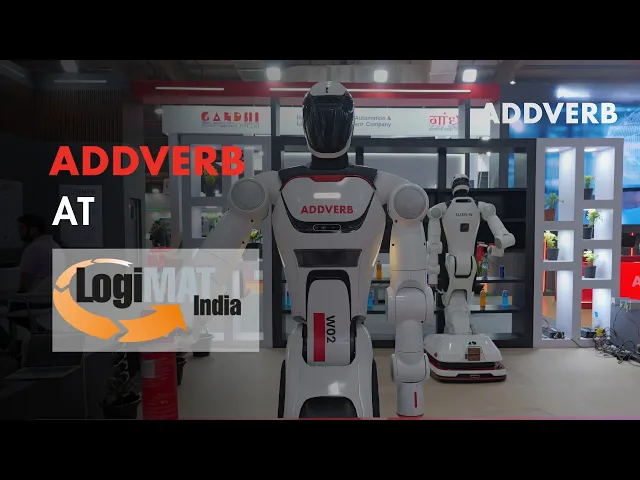
This is the shift Addverb is building towards across Trakr, Syncro, and Elixis, three different embodiments of the same underlying idea.
Frequently Asked Questions
What is Physical AI?
How is Physical AI different from digital AI?
What are the two core capabilities of a Physical AI robot?