SYNCRO
ELIXIS
PHYSICAL AI

7 MINS
|
19 AUG 2026
Summary: Physical AI robots learn from imitation learning and real-world experience. Before a robot can pick up fragile objects, assemble components, or navigate complex environments, it needs accurately annotated training data that captures how humans perform these tasks. This is where data collection for robotics manipulation becomes critical. By combining data from direct teleoperation, human demonstrations, data gloves, tactile sensing engineers can train robots to perform real-world tasks consistently, and at scale.
A Robot That Grips a Bolt and an Egg the Same Way Will Crush the Egg.
A robot arm can look flawless in a controlled test and still fall apart on the floor. It grips too hard and crushes a fragile part. It doesn't recognize that a grasp has slipped until the object is already on the ground. It freezes in a cluttered bin it's never seen before, because the training data never included clutter like that. None of this is a modeling problem. It's a data problem.
While Large Language Models (LLMs) learn from vast amounts of text, images, and videos, physical AI systems aspire to do a lot more than just identifying an object. A visual model can help it differentiate between an egg and a ball but it needs to understand how to go about picking them up, that is it must learn not only from knowledge but also from actions and interactions in the real world.
Robotic data collection programs target to capture learnings like the ones listed below:
How much force to apply while picking something
How to recover when a grasp slips
What are the desired positions to achieve
How fast or slow to approach an object
What counts as a completed task
These capabilities cannot be learned from text or images alone. They require large amounts of real-world behavioural data and more importantly, they need data that can be interpreted by a robotic system
How is the data for Robotics Manipulation Collected?
Teleoperation is one of the most common ways to collect this data. As a human operator controls a robot, the system records rich multimodal information, including camera feeds, joint states, end-effector positions, force and torque measurements, gripper states, and task timing. This raw data captures not only what actions were taken, but also how and why they were performed.
But none of it is labelled or structured by default.
Raw capture gives you signals. What transforms raw recordings into valuable training data is the annotation and curation layer built on top of them. This layer adds critical context, including:
Task and instruction labels for every episode
Episode segmentation, including sub-task and phase boundaries such as approach, contact, grasp, transport and release
Outcome labels covering success, partial success and failure, with failure modes categorized
Quality grading, so fumbled or hesitant demonstrations are flagged rather than silently trained on
Scene and object metadata, including object variant, lighting, clutter level and starting configuration
Curation decisions on which episodes to keep, down-weight or discard
Without this layer, even the most advanced AI models see only streams of sensor data and robot actions.
How is Data Annotation for Robotics Different from Data Annotation for Traditional AI?
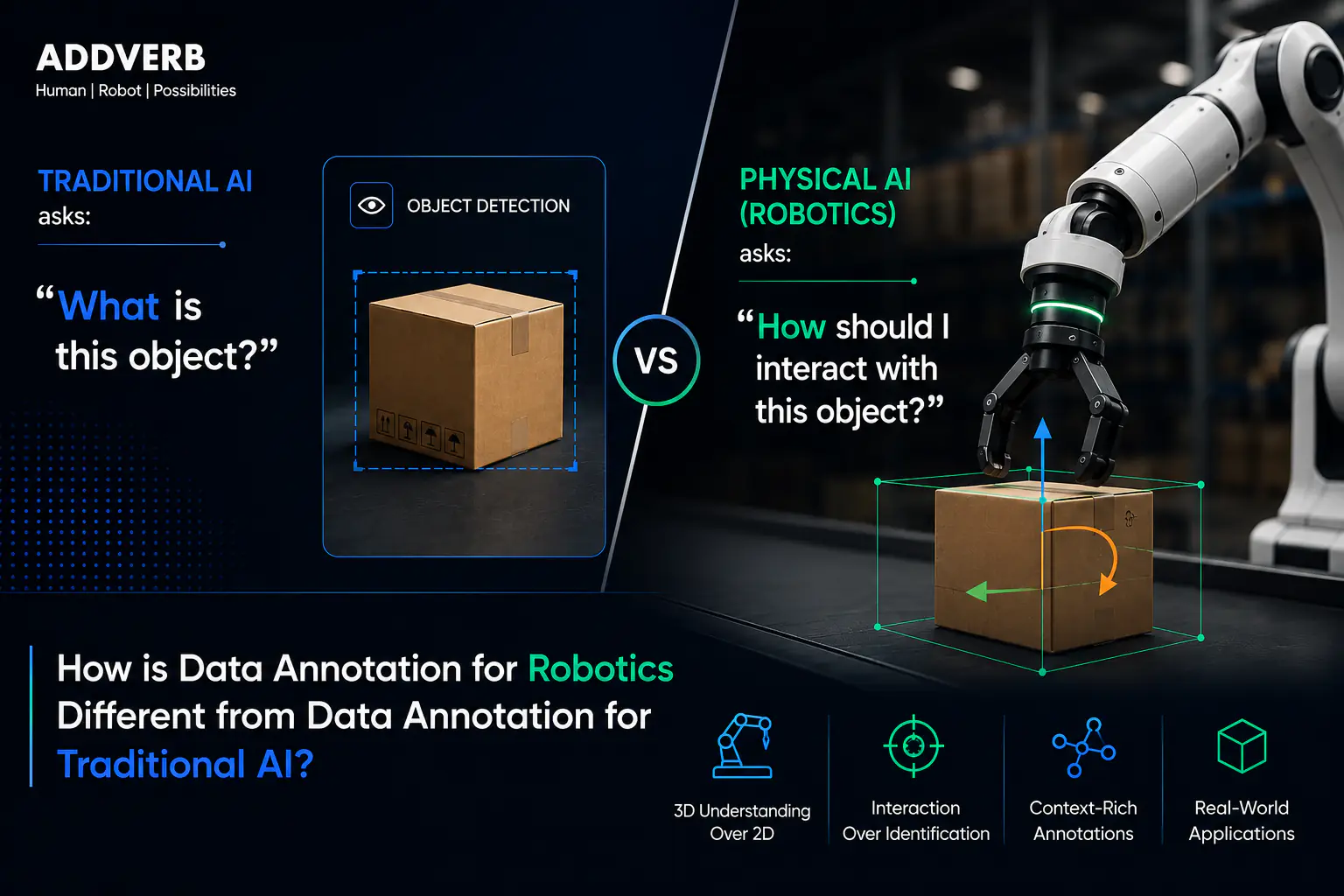
Dimension | Traditional AI annotation | Robotics data annotation |
Unit of annotation | A single image or frame | A full episode: one time-sequenced demonstration from start to outcome |
What humans label | What is present in the frame: classes, boundaries, regions, keypoints | What happened across the sequence: task instruction, phase boundaries, outcome, demonstration quality |
Where labels come from | Applied entirely after collection, by annotators | Actions are captured during teleoperation and self-label; humans add task, segmentation, outcome and quality judgments on top |
Role of time | Mostly frame-independent; frame order rarely affects label validity | Temporal alignment is a correctness requirement. Streams run at different rates, and drift of tens of milliseconds silently corrupts observation-action pairs |
Definition of quality | Label accuracy and inter-annotator agreement | Label accuracy, plus whether the demonstration |
Treatment of failures | Errors to be found and removed | A labeled category to keep, needed for success metrics, failure diagnosis and recovery behavior |
What Data Does a Robot Need to Learn?
Modern robots don't learn from cameras alone. It trains through Behavioural learning.
Depending on the task, robot design, and sensing capabilities, they may collect and synchronize data from a variety of sources, including:
RGB cameras
Depth cameras
Joint positions
End-effector trajectories
Force and torque sensors
Gripper state
IMU data (Inertial Measurement Unit)
Environmental and contextual feedback
Together, these signals help robots learn not only what they see, but also how they should move, adapt, and interact with the physical world.
How Does Direct Teleoperation Improve Data Annotation?
One of the biggest challenges in robotics is collecting demonstrations that reflect how tasks are performed in real-world environments.
Instead of manually programming every movement, operators directly control the robot through teleoperation.
Every movement performed by the operator automatically generates valuable training data.
During teleoperation, the system may record multiple synchronized data streams, including:
Robot joint angles
End-effector poses
Force and torque measurements
Camera feeds
Object interactions
Task completion states
Timing and sequence information
This rich behavioural data provides annotators with the context needed to label tasks, segment workflows, identify success and failure cases, and capture subtle aspects of human decision-making.
Each successful demonstration becomes a high-quality example for AI model training, and failures are just as valuable, to teach the robot how to recover and what not to repeat.
This approach allows robots to learn from human expertise rather than predefined motion scripts.
What makes Addverb the right choice for Data Collection for Robotics?
Most teams treat annotation as something that happens after data collection, a cleanup step.
At Addverb, our approach combines direct robot teleoperation, synchronized sensor capture, data curation and structured annotation pipelines to create high-quality datasets for Physical AI training. we treat it as a pipeline that runs alongside teleoperation itself, because a demonstration isn't useful until it's been broken into:
Task and instruction labels for every episode
Phase boundaries: approach, contact, grasp, transport, release
Outcome labels: success, partial success, or failure, with failure modes categorized (not just discarded)
Quality grading: so a hesitant or fumbled demonstration gets flagged instead of silently trained on
Scene and object metadata: variant, lighting, clutter level, starting configuration
Curation decisions: which episodes to keep, downweight, or drop entirely
This is a fundamentally different unit of work than traditional AI annotation, which labels a single frame in isolation. Robotics annotation must label an entire time-sequenced episode, where the order of events is the information, and a timing drift of a few tens of milliseconds between sensor streams can silently corrupt an observation-action pair.
This human-in-the-loop approach enables our robots to imitate and learn complex manipulation tasks that are difficult to define through conventional programming.
What Applications Benefit from Robotics Data Annotation?
High-quality robotics datasets are fundamental to building Physical AI systems that can perceive, reason, and act reliably in the real world. These include:
Pick-and-place operations
Warehouse automation
Bin picking
Industrial assembly
Machine tending
Cable insertion
Connector plugging
Packaging
Palletizing
Quality inspection
Cloth folding
Humanoid manipulation and assistance
For these applications, annotated data provides the context needed to understand task intent, evaluate outcomes, and learn effective actions. As robots are deployed across increasingly diverse environments, high-quality annotated datasets become essential for improving adaptability, robustness, and task success rates.
Why Is Data Quality in Robotics Data Annotation More Important Than Data Volume?
Collecting thousands of demonstrations is not enough. Incomplete annotations, inconsistent labelling, and low-quality demonstrations can introduce noise that makes imitation learning harder for models.
A robust visual annotation pipeline should include:
Supervised Annotation workflows
Annotation validation workflows
Quality Assurance checks
Continuous dataset refinement and curation
High-quality datasets help AI models learn more effectively, generalize to new environments, and perform reliably in scenarios they have never encountered before.
How Is Robotics Data Annotation Shaping the Future of Physical AI?
The next generation of robots will not rely solely on predefined instructions. Instead, they will continuously learn from demonstrations, interactions, and feedback collected across real-world environments.
This is where Addverb's approach to robotics data annotation creates an advantage. Rather than treating data collection as a one-time exercise, Addverb has built a 24×7 data engine designed to continuously generate robot demonstrations at scale.
Our data collection combines direct teleoperation, simulation, and structured annotation workflows, allowing us to build datasets across different tasks, environments, and levels of complexity. A larger and more diverse set of demonstrations gives Physical AI models more examples of how a task can be performed and how robots should respond to variations in the real world.
Scale is also critical. Addverb's teleoperation capacity has grown from 4 hours of data collected per week in December 2025 to 250 hours per week, representing a 60× improvement in weekly teleoperation data collection. This allows us to generate substantially more training data while continuously expanding the range of tasks and scenarios covered.
The data engine is supported by tools that can be run across the data collection workflow and 25+ interns working across shifts, helping maintain continuous data generation rather than limiting collection to conventional working hours.
Conclusion
Robotics data annotation is much more than labelling information. It's the foundation on which Physical AI is built. Robots require more than perception. It must understand how to act, adapt, and interact within dynamic real-world environments.
At Addverb, this approach enables the development of intelligent robotic systems that continuously learn from human demonstrations, making automation more capable, adaptable, and scalable across industries. By combining direct teleoperation with synchronized sensor data, reinforcement learning and structured annotation workflows, we help create high-quality datasets that teach robots how to interact with the real world.
Interested in how real-world robot demonstrations become AI-ready training data? Talk to our Physical AI experts!
Frequently Asked
What is robotics data annotation?
How does teleoperation help with data annotation?
Which industries benefit from robotics data annotation?
What types of data does Addverb collect during teleoperation?
Why is data annotation important for Physical AI?