TRAKR
QUADRUPED ROBOT
PHYSICAL AI

4 mins
|
30 October 2026
Construction managers who run several live projects cannot compare site risk, because each site records conditions in its own way. A robot dog walks the same route and checkpoints on every site and keeps a dated record, so managers can compare risk across the portfolio.
A robotic dog is a quadruped robot that walks a set route, carries cameras and sensors, and records site conditions without placing a person in hazardous areas.
It does the repetitive walking and goes first into unsafe places. This article does not cover robots that build, lay bricks or operate machinery.
Key takeaways
Manual inspection records are inconsistent. A January 2026 ASCE study measured field rework at 0.38% to 0.76% of contract value, against earlier estimates of up to 12.4%, and concluded that better documentation improves cost forecasting.
Falls, slips and trips caused 370 of the 1,032 US construction and extraction fatalities in 2024 (BLS). The robot goes first into hazardous zones, and the safety officer decides whether people enter.
It suits multi-level, basement and hazardous sites that engineers walk daily. Drones remain faster for roofs and facades, and a phone and a checklist cover small single-storey sites more cheaply.
Battery and payload set the limits. Addverb's Trakr runs for about 90 minutes per charge and carries 5 kg (20 kg for Trakr 2.0), so teams plan routes around charging.
Why do manual site inspections fall short?
Because inspection still relies on people walking the site and recording conditions by hand, and the resulting record is inconsistent. A January 2026 study by Peter E. D. Love in the ASCE Journal of Construction Engineering and Management analysed actual contractor rework records rather than survey estimates. Earlier studies had put rework as high as 12.4% of contract value. The measured figure averaged 0.38% of contract value before completion and 0.76% once he added post-completion corrections.
ASCE's summary of the study concludes that better documentation and analysis of rework can improve quality management and cost forecasting. Inspection is where that documentation begins. When engineers record a walk-through as handwritten notes and phone photographs, the result is difficult to search and to compare with the previous week's. One caveat: the figures come from one contractor's projects, so they indicate a direction rather than a benchmark for any particular site.
How does a robot dog inspect a construction site?
It learns the site once, then walks it on a schedule. On the first run, the robot builds a map using LiDAR (light detection and ranging, which measures distance with laser pulses) and its cameras. After that, it follows a fixed route and stops at the same checkpoints each time, so the robot takes every photo from the same angle as the last one.
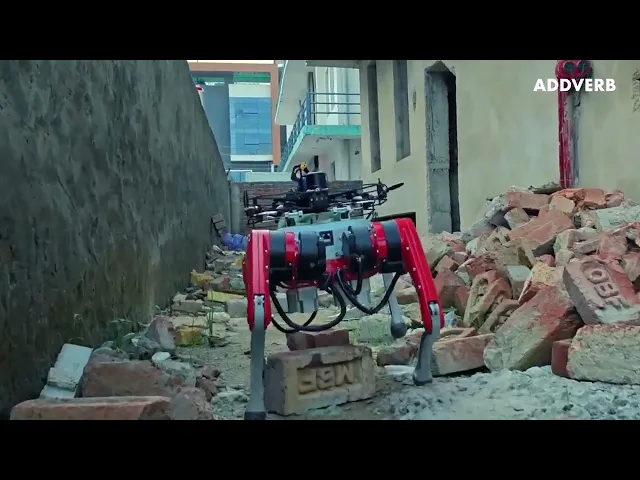
A slab crack, a moved barrier or water pooling near a shaft shows up as a difference between two matching images, not as something an engineer happened to notice. Legs matter too: a quadruped steps over rebar offcuts, rubble and loose ground where a wheeled robot would stall.
Where should a robot go instead of a person?
Into locations where sending a person carries real risk. The US Bureau of Labor Statistics recorded 1,032 fatal injuries among construction and extraction workers in 2024, and 370 of them came from falls, slips and trips.
The robot is most useful on routes such as these:
Open slab edges and shafts before guardrails go up.
Freshly excavated areas where ground stability is unconfirmed.
Basements or pits where gas could collect.
Zones after a partial collapse or fire, before an engineer has cleared them.
Night patrols across an unlit, half-finished site.
The robot goes first and reports back. The safety officer still decides whether people go in.
Robot dog vs drone vs fixed camera vs walk-through
Most sites use more than one method.
Method | Best at | Works indoors and underground? | Weak spot |
Engineer walk-through | Judgement, touch, spotting the unexpected | Yes | Time, fatigue, exposure to hazards |
Fixed CCTV cameras | Watching one area all day | Only where mounted | Blind spots that move as the building grows |
Drone | Roofs, facades, site-wide overview | Poorly, in tight or GPS-denied spaces | Short flights, restrictions near people |
Robot dog | Repeat ground-level routes, going first into risky zones | Yes | Battery limits, vertical ladders |

What does each person on the project team get from it?
Site and project managers
A daily record of the same checkpoints, so teams settle progress disputes and missed defects with dated images rather than recollection.
Safety and compliance heads
A way to check a hazardous zone before anyone enters it, plus a log of every patrol for audits.
Engineering and technology leads
Sensor data that can flow into tools the site already uses. Addverb says Trakr can connect with existing video management and access control systems to stream live data and send alerts with context to operators.
Owners and senior leadership
Teams find problems earlier, when they are cheaper to fix, and hold a defensible record if something goes wrong. Payback depends on site size, route length and how often you inspect today.
What are the limits of a robot dog on site?
Battery life is the first limitation. Addverb's first-generation Trakr runs for about 90 minutes on a charge, so operators must split a long route around charging, or the robot covers the high-risk stretch and engineers cover the rest.
Payload is the second. Trakr carries 5 kg, which limits how many extra sensors you can mount; Trakr 2.0 raises that to 20 kg. Legged robots also do not climb vertical ladders, and a drone will survey a roof or facade faster.
A robot dog suits sites with multiple floors, basements or zones you would rather not send people into, where engineers walk the same route every day. It suits sites less well if they are a single storey, mostly open to the sky, or small enough for one engineer to cover in under an hour.
How Trakr fits a construction site
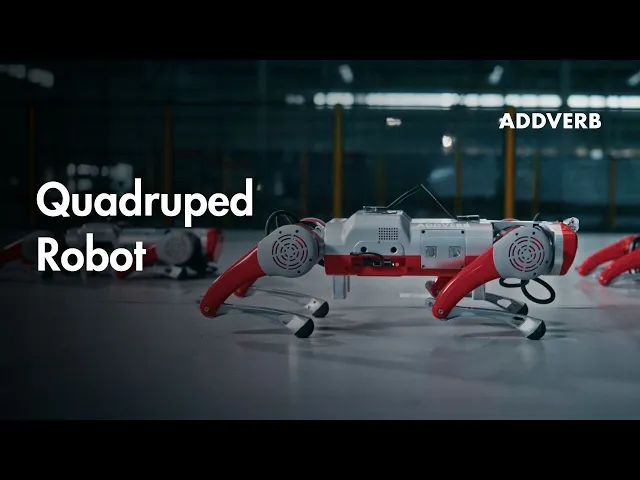
Addverb designs and builds Trakr, its quadruped robot, in India. It has 12 actuators for leg control, four stereo cameras for depth perception, and LiDAR for mapping and obstacle avoidance. Addverb lists construction among its target sectors, alongside oil, defence and security.
For inspection, teams can configure Trakr to look for thermal irregularities, gas leaks, blocked paths and unauthorised access, and to flag them to the team on duty. Explore Trakr's specifications to see how it would map to your site's routes.
Trakr walks and records; your engineers and safety officers make the decisions.
How to start a robot dog pilot on one route
A robot dog is worth considering when the same inspection walk consumes your engineers' mornings and part of it is somewhere you would rather not send a person. Select that route this week. Note how long it takes, how often engineers walk it and which points on it carry the most risk. That is your pilot brief.
When you have it, speak to our robotics team about walking that route with Trakr.
Frequently asked questions
What is a robot dog used for in construction?
Will a robot dog replace site engineers or safety officers?
How long can a robot dog run on one charge?
Can a robot dog work indoors where drones struggle?
Is a robot dog worth it for a small site?